Source automatic pe plastic hospital bed for clinics, surgeries, and rehab
Explore 30 listings for the automatic pe plastic hospital bed designed for medical facilities. Buyers can compare electric and manual models, material types, and functional variations to find suitable equipment for hospitals and clinics.
Key considerations
Products List




Comprehensive Sourcing Guide
Strategic Sourcing Guide for Automatic PE Plastic Hospital Beds
Understanding Product Definitions and Functional Variations
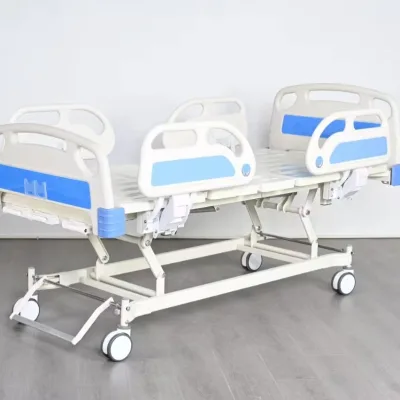
When sourcing an automatic PE plastic hospital bed, buyers must first navigate the complex terminology often found in B2B marketplaces. The core keyword suggests a bed constructed with a plastic frame or components, powered by an electric mechanism, and intended for healthcare environments. However, the available market data reveals a diverse spectrum of configurations that do not always align perfectly with a single "automatic PE plastic" definition. Procurement teams must distinguish between beds labeled as "Electric Bed" and those designated as "Manual Bed," as the actuation mechanism fundamentally changes the operational workflow and maintenance requirements.
The market data indicates a significant variation in functional capabilities. While some units are described as having "Two-function" or "Three-function" capabilities, others are listed with "Five-function" specifications. These numbers typically refer to the independent articulation points of the bed, such as the headrest, backrest, and legrest. A buyer seeking an "automatic" system must verify that the specific model supports electric adjustment for these functions. Furthermore, the material composition is not uniform; while the search term specifies "PE plastic," the observed product attributes list "Metal" as a primary material for some electric models, while "Plastic" is noted for others. This discrepancy suggests that "PE plastic" may refer to specific surface components, such as the mattress or side rails, rather than the entire structural frame. Buyers must carefully inspect the product description to determine if the frame is metal with plastic accents or if the structure relies on high-density plastic polymers, as this impacts durability and load-bearing capacity.
Technical Specifications and Dimensional Standards
Technical due diligence is critical when evaluating hospital beds, as dimensions and mechanical ranges directly affect patient care and facility compatibility. The observed product data provides specific dimensional standards that serve as benchmarks for verification. Several models are listed with dimensions such as 2000960500mm, 2050x960x500mm, and 22001040500mm. These variations in length and width indicate that a "one-size-fits-all" approach is not viable. Procurement teams must match the bed dimensions to the available space in patient rooms, ensuring that the width (typically around 900mm to 1040mm) allows for adequate maneuvering space for medical staff and equipment.
The articulation ranges are equally important for patient comfort and clinical utility. The data highlights specific angular adjustments, such as a backrest range of 0-75 degrees and a legrest range of 0-20 degrees. Another attribute mentions a backside range of 0-80 degrees. When sourcing an automatic bed, it is essential to confirm that the electric motor system can reliably achieve these specific angles without stalling or requiring manual intervention. The "Folded" attribute appears in the data as both "Folded" and "Unfolded," suggesting that some models may be designed for compact storage or transport, while others are intended for permanent installation. Buyers should verify if the "automatic" feature includes a folding mechanism or if the bed remains in a fixed, unfolded state during operation.
Additionally, the product models listed, such as RJ-M303, 013, 001, JREIII06, and A04-2, serve as unique identifiers. These model numbers often correlate with specific feature sets. For instance, the model A04-2 appears multiple times with different dimensional standards, indicating potential revisions or variations in the same product line. Buyers must cross-reference the model number with the specific dimensional and functional requirements of their facility to avoid purchasing a unit that is too small or lacks necessary adjustment ranges.
Compliance, Certification, and Regulatory Alignment
Navigating the regulatory landscape is a non-negotiable aspect of medical equipment procurement. The supplied facts explicitly mention certifications such as ISOCE and standards including CE and ISO. These are high-confidence indicators of compliance, but buyers must understand the scope of these certifications. The presence of "CE" and "ISO" on the product attributes suggests that the manufacturer adheres to European conformity and international quality management standards. However, the specific version of the ISO standard (e.g., ISO 9001 for quality management or ISO 13485 for medical devices) is not detailed in the provided data.
Buyers should verify that the "ISOCE" certification mentioned applies to the specific product model being purchased and is current. In many jurisdictions, medical beds must meet specific electrical safety standards and biocompatibility requirements for materials in contact with patients. The data notes that the "Using Ambient" for these products is "Hospital," which implies a design intent for clinical environments. However, the term "Commercial Furniture" also appears in the attributes, creating a potential classification ambiguity. A bed marketed as commercial furniture may not meet the rigorous infection control and safety standards required for a hospital setting. Procurement teams must request the full certification dossier to confirm that the bed is cleared for medical use and not just general commercial use.
Furthermore, the origin of the products is listed as "China" or "P. R. China." While this is a common manufacturing hub for medical equipment, it necessitates a thorough review of the supplier's export compliance and the specific regulatory approvals granted by the destination country's health authority. The "Standard" attribute also lists dimensional values like L2030W900H500mm, which can sometimes be confused with regulatory standards. Buyers must ensure that the listed "standards" refer to physical dimensions and not to safety codes, and that the actual safety codes (like IEC 60601 for medical electrical equipment) are explicitly stated in the technical documentation.
Cost Drivers and Economic Considerations
The economic landscape for automatic hospital beds is influenced by a wide range of factors, as evidenced by the observed price range of 11.5 to 1350 USD. This massive variance suggests that the "automatic pe plastic hospital bed" category encompasses everything from basic, single-function units to complex, multi-function systems with advanced features. The lower end of the price spectrum likely corresponds to manual beds or electric beds with limited functionality, while the higher end reflects fully automated, five-function beds with premium materials and extended warranties.
The Minimum Order Quantity (MOQ) is another significant cost driver, with observed ranges from 1 to 100 units. For small clinics or pilot programs, an MOQ of 1 allows for flexibility, whereas larger hospital chains may benefit from bulk purchasing at an MOQ of 100. However, the cost per unit often decreases with volume, so buyers should negotiate based on their total projected need rather than just the immediate order size.
Material composition plays a pivotal role in pricing. Beds constructed primarily with "Metal" frames generally command a higher price than those using "Plastic" due to the durability and load-bearing capacity of metal. However, if the "PE plastic" component is a high-grade, medical-grade polymer, it may add to the cost despite being lighter. The "Product Name" listed as "Medical Bed" alongside "General Use: Commercial Furniture" indicates that price differentiation may also stem from the intended use case. A bed designed for high-traffic hospital wards will cost more than one intended for a massage table or commercial setting, even if the physical appearance is similar.
Typical Applications and Operational Context
The operational context of the bed dictates the necessary features. The data explicitly states "Using Ambient: Hospital," confirming that these units are designed for clinical environments. However, the attribute "Specific Use: Massage Table" introduces a dual-purpose potential. Some models may be versatile enough to serve both medical and therapeutic roles, such as in physiotherapy departments or rehabilitation centers. The "Design Style: Contemporary" suggests a focus on aesthetics, which is increasingly important in modern healthcare facilities to reduce patient anxiety.
The "Feature: Strong Elasticity and Moderate Softness" points to the quality of the mattress or padding, which is crucial for patient comfort and pressure ulcer prevention. In a hospital setting, the ability to adjust the bed's position automatically is vital for patient care, including procedures like surgery, imaging, and post-operative recovery. The "Two-function," "Three-function," and "Five-function" distinctions are particularly relevant here. A five-function bed allows for independent adjustment of the head, back, knee, and leg sections, providing superior positioning for patients with specific medical needs.
Buyers must also consider the "Condition: New" attribute. While this seems straightforward, it is essential to verify that the "New" condition includes all necessary accessories, such as side rails, wheels, and control panels. The "Folded" attribute suggests that some models may be designed for easy storage or transport, which is beneficial for facilities that need to reconfigure rooms frequently or for mobile medical units.
Supplier Evaluation and Quality Assurance
Evaluating suppliers for automatic hospital beds requires a rigorous approach to quality assurance. The data lists "Warranty: 1 Year" and "1year" as well as "Maintence: 5 Years" and "Sparre Parts Supply: 10 Years." These figures represent the supplier's confidence in their product's longevity. A 10-year spare parts supply commitment is a strong indicator of a reliable manufacturer, as it ensures that the bed can be maintained long after the initial warranty expires. However, buyers must verify if these terms are standard across all models or specific to certain high-end units.
The "prod_packing" attribute varies between "Carton," "Carton/Wooden Case," and "Export Paper Carton Box." Proper packaging is essential for preventing damage during international shipping, especially for beds with delicate electronic components. Wooden cases often provide superior protection for heavy or fragile items, while standard cartons may be sufficient for lighter units. Buyers should inspect the packaging specifications to ensure they align with the fragility of the product.
When evaluating suppliers, the "prod_origin" of China is a common factor. Buyers should verify the supplier's track record in exporting medical equipment and their ability to navigate customs and regulatory requirements. The presence of multiple model numbers (e.g., A04-2, A06, WS01-3) suggests a diverse product line, but buyers should ensure the supplier has the capacity to support the specific model they are purchasing. The "Metal Type: Metal" attribute indicates that the frame material is a key specification, and buyers should request details on the type of metal used (e.g., steel, aluminum) to assess corrosion resistance and weight.
Long-Term Procurement and Lifecycle Management
Long-term procurement considerations extend beyond the initial purchase price. The "Maintence: 5 Years" and "Sparre Parts Supply: 10 Years" attributes highlight the importance of lifecycle management. Buyers should develop a maintenance plan that aligns with these timelines, ensuring that regular inspections and servicing are scheduled to maximize the bed's operational life. The "Warranty: 1 Year" is a standard starting point, but the extended maintenance and parts supply commitments suggest that the supplier is prepared to support the product for a decade.
The "Automatic" nature of the bed introduces electrical components that may require specialized maintenance. Buyers should verify if the supplier offers training for hospital staff on the operation and basic troubleshooting of the electric mechanisms. The "Using Ambient: Hospital" context implies that the bed will be subjected to frequent use and potential exposure to cleaning chemicals, so the durability of the plastic and metal components is critical.
Finally, the "Design Style: Contemporary" and "Feature: Strong Elasticity and Moderate Softness" suggest that the bed is designed for both functionality and patient comfort. As healthcare trends evolve, the ability to adapt the bed to new care protocols is essential. Buyers should consider the modularity of the bed and the availability of future upgrades or accessories. The "Carton/Wooden" and "Export Paper Carton Box" packaging options also play a role in the long-term logistics of storage and replacement, ensuring that the bed can be easily moved or replaced if necessary. By focusing on these long-term factors, buyers can ensure a sustainable and cost-effective procurement strategy for their medical facilities.
FAQs
What certifications do automatic PE plastic hospital beds have?
These beds typically hold ISOCE certification and meet CE and ISO standards. Buyers must verify that the specific model matches these high-confidence facts, as some listings also mention commercial furniture use which may differ from strict medical compliance.
How many functions are available for these hospital beds?
Models range from two-function to five-function configurations depending on the specific unit. The function count refers to independent articulation points like headrest and legrest, with some models offering up to five distinct adjustment capabilities for patient positioning.
Can I find automatic electric beds made of metal frames?
Yes, electric beds are available with metal frames alongside plastic components. While the search term suggests plastic, observed attributes confirm metal as a primary material for some electric models, indicating a mix of structural materials in the market.
What are the standard dimensions for these hospital beds?
Common dimensions include lengths of 2000mm, 2050mm, or 2200mm with widths around 960mm. Specific models list standards like 2000*960*500mm or 2200*1040*500mm, so buyers must match these exact measurements to their facility space.
What is the warranty and maintenance period for these beds?
Standard offerings include a one-year warranty with maintenance support for five years. Suppliers also commit to spare parts supply for up to ten years, ensuring long-term operational support for the medical equipment in hospital settings.
Which origin countries supply these automatic hospital beds?
Products are primarily sourced from China or the People's Republic of China. Buyers should confirm the specific origin listed for their selected model, as this affects export compliance and regulatory alignment for their destination market.